Top Female Alpine Ski in World Cup
title image reference
title image reference
Introduction
This site introduces a data-focused look at elite women's alpine skiing, using competition history as a way to understand long-term performance and competitive dominance. Rather than treating results as isolated moments, the project emphasizes patterns that emerge across seasons and careers.
With the 2026 Milano Cortina Winter Olympics approaching, the goal of this site is to explore how past World Cup performance might inform expectations around competitive strength and medal potential. The project invites users to consider probability, consistency, and momentum as key factors shaping future outcomes.
Players' Data
| Overall Crystal Globes | Racer | Total Crystal Globes | Wins | Podiums |
|---|---|---|---|---|
| 6 | Annemarie Moser-Pröll (AUT) | 16 | 62 | 114 |
| 5 | Mikaela Shiffrin (USA) | 16 | 101 | 157 |
| 4 | Lindsey Vonn (USA) | 20 | 82 | 138 |
| 3 | Vreni Schneider (SUI) | 14 | 55 | 101 |
| 3 | Janica Kostelic (CRO) | 6 | 30 | 55 |
| 3 | Petra Kronberger (AUT) | 4 | 16 | 35 |
| 2 | Katja Seizinger (GER) | 11 | 36 | 76 |
| 2 | Lara Gut-Behrami (SUI) | 9 | 48 | 101 |
| 2 | Michela Figini (SUI) | 8 | 26 | 46 |
| 2 | Anja Pärson (SWE) | 7 | 42 | 95 |
| 2 | Erika Hess (SUI) | 7 | 31 | 76 |
| 2 | Federica Brignone (ITA) | 7 | 37 | 85 |
| 2 | Maria Walliser (SUI) | 6 | 25 | 72 |
| 2 | Hanni Wenzel (LIE) | 5 | 33 | 89 |
| 2 | Anna Veith Fenninger (AUT) | 4 | 15 | 46 |
| 2 | Nancy Greene (CAN) | 4 | 14 | 20 |
| 1 | Renate Goetschl (AUT) | 9 | 46 | 110 |
| 1 | Michaela Dorfmeister (AUT) | 6 | 25 | 64 |
| 1 | Maria Riesch Hoefl (GER) | 6 | 27 | 81 |
| 1 | Lise Marie Morerod (SUI) | 6 | 24 | 41 |
| 1 | Tamara McKinney (USA) | 4 | 18 | 45 |
| 1 | Petra Vlhova (SVK) | 3 | 31 | 73 |
| 1 | Tina Maze (SLO) | 3 | 26 | 81 |
| 1 | Marie Therese Nadig (SUI) | 3 | 24 | 57 |
| 1 | Anita Wachter (AUT) | 3 | 19 | 75 |
| 1 | Alexandra Meissnitzer (AUT) | 3 | 14 | 44 |
| 1 | Pernilla Wiberg (SWE) | 2 | 24 | 61 |
| 1 | Nicole Hosp (AUT) | 2 | 12 | 57 |
| 1 | Rosi Mittermaier (GER) | 2 | 10 | 41 |
| 1 | Michelle Jacot (FRA) | 2 | 10 | 21 |
| 1 | Gertrud Gabl (AUT) | 2 | 7 | 17 |
Analysis
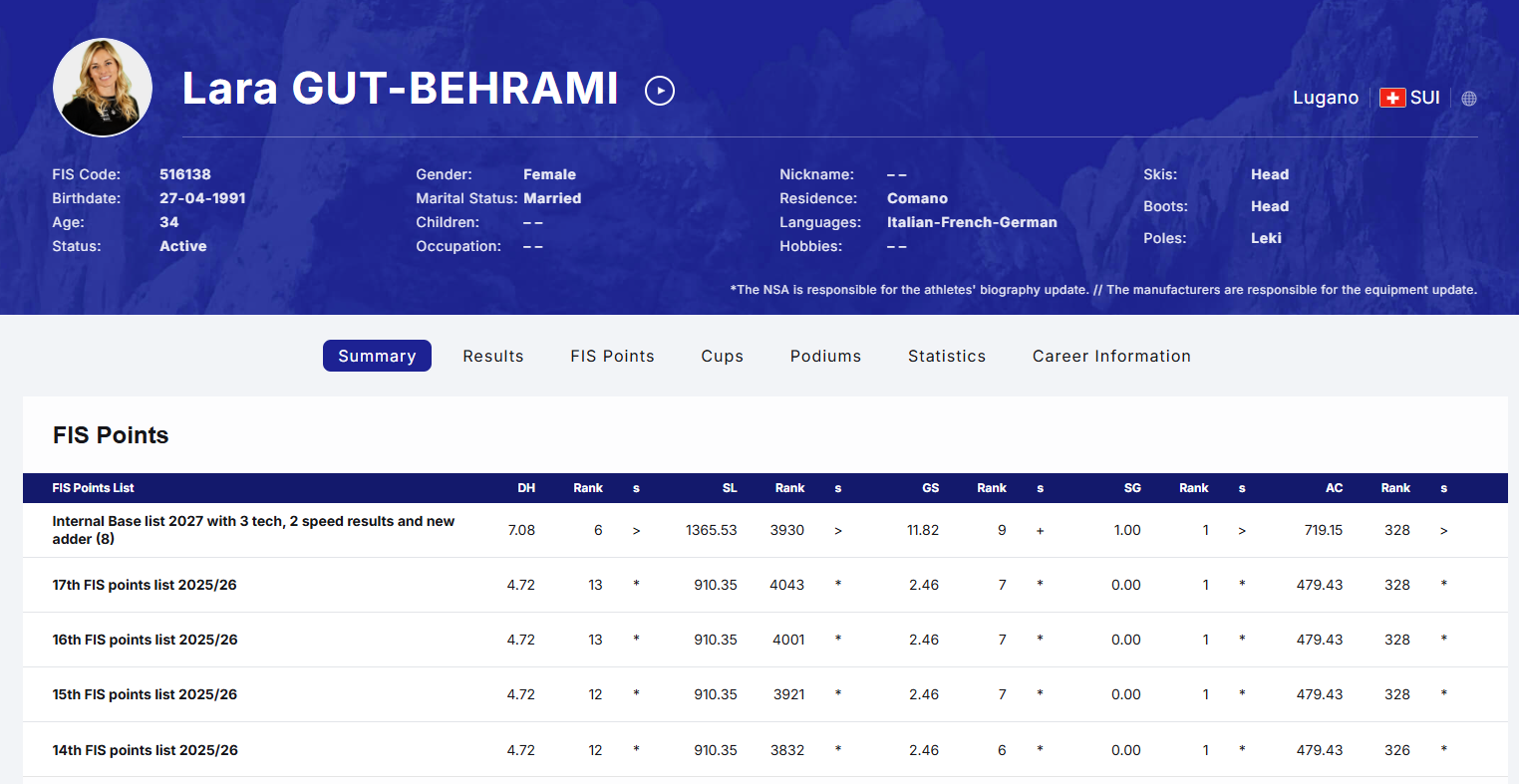
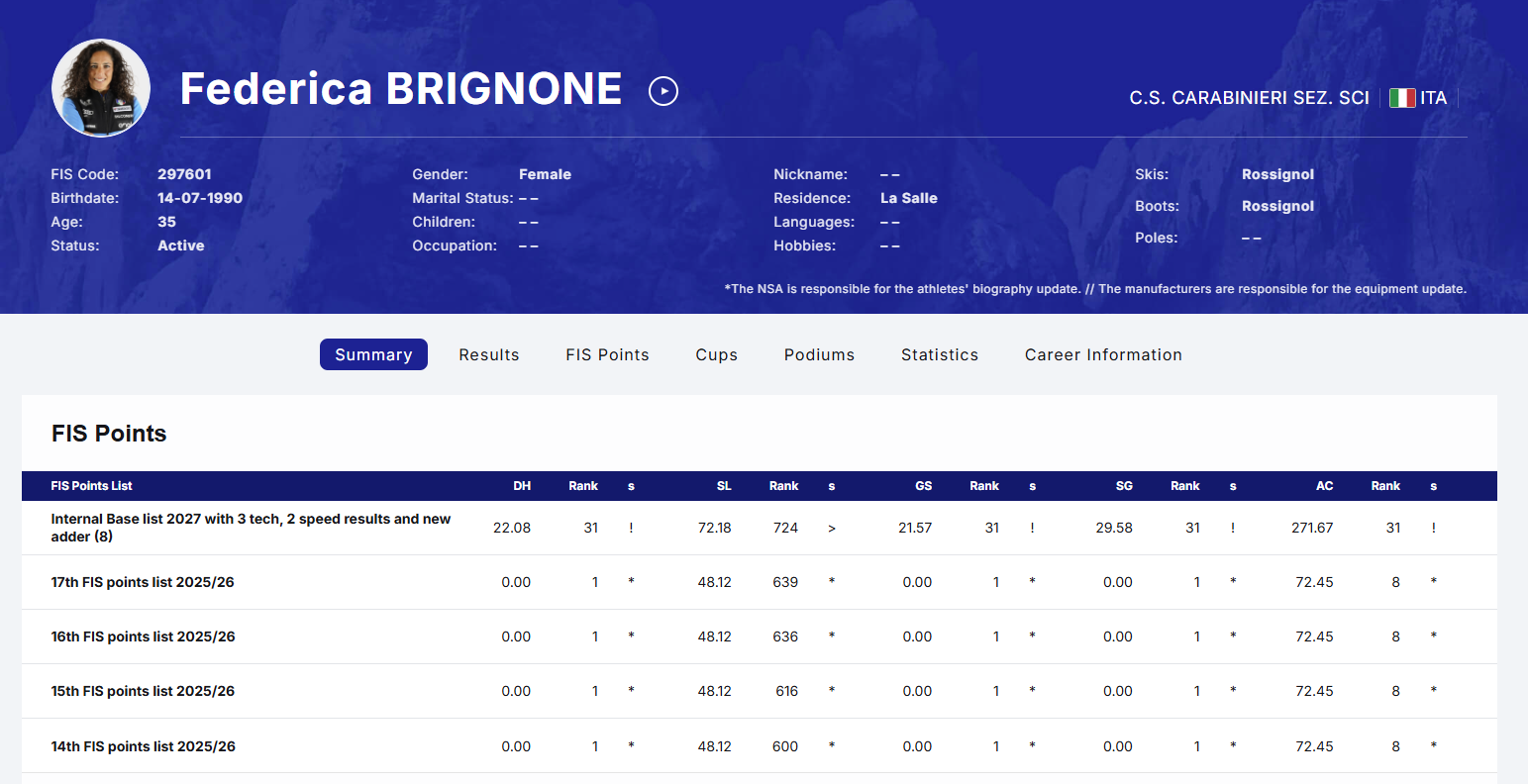
In the table above, the four rows highlighted in blue represent active athletes who are eligible to compete in the 2026 Winter Olympic Games.
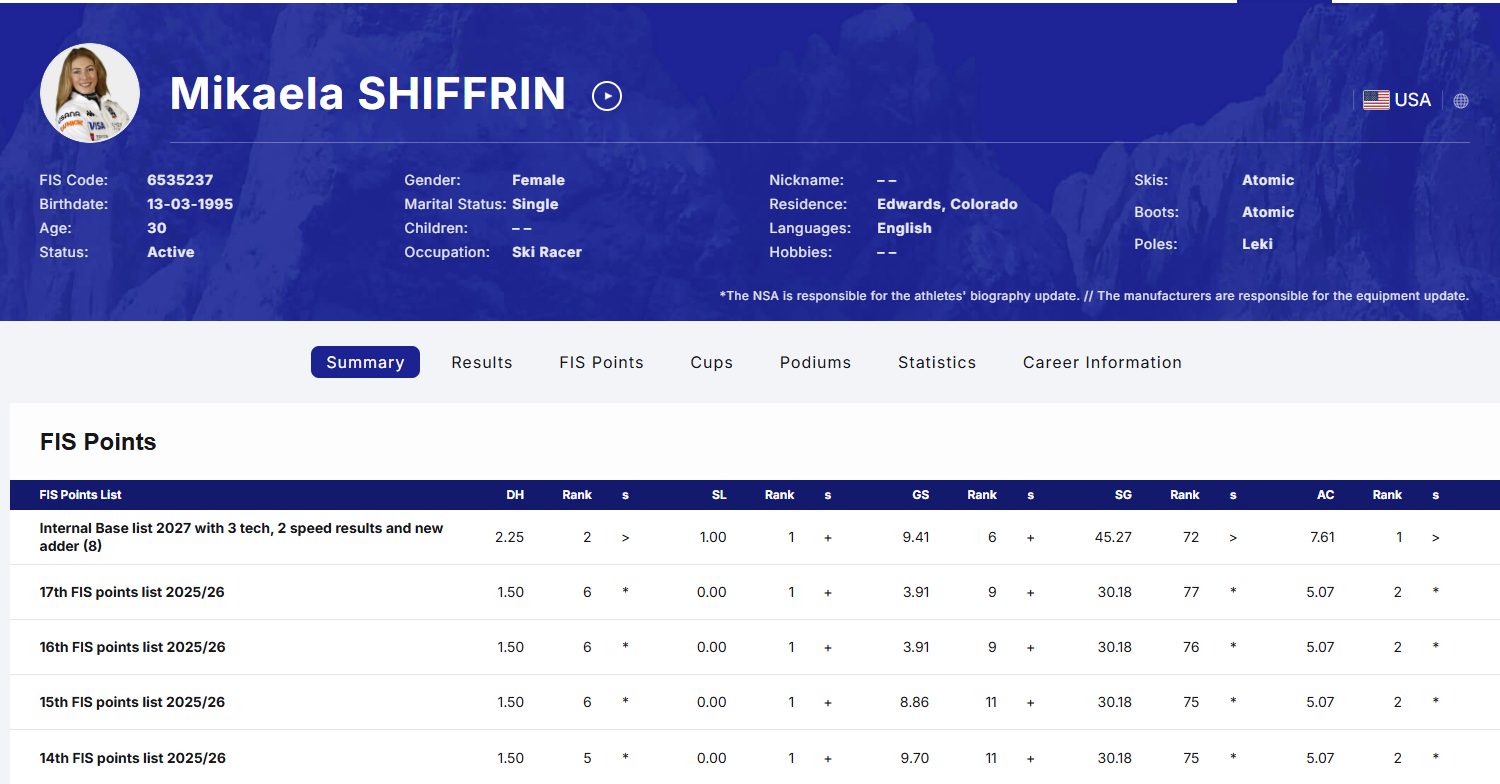
Based on recent FIS Points data, these four athletes enter the new season with clearly differentiated competitive profiles that reflect both their strengths and strategic focuses. Mikaela Shiffrin continues to demonstrate exceptionally low points across both technical and speed disciplines, indicating not only peak performance but also long-term consistency. This balance suggests a reduced performance risk across varying courses and conditions, reinforcing her position as the most stable all-around contender heading into the Olympic cycle.
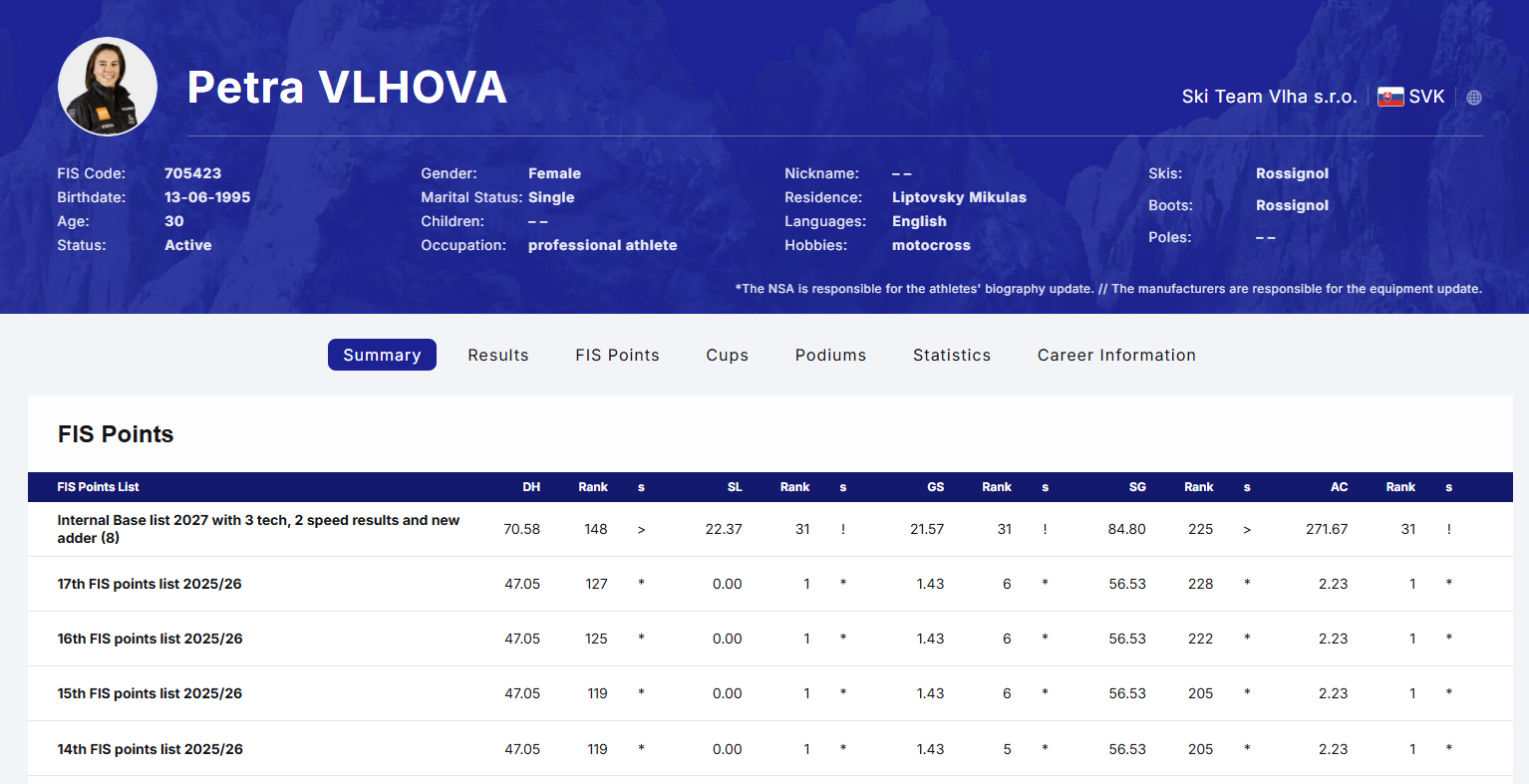
Petra Vlhova's data reveals a contrasting profile, marked by strong specialization in technical events, particularly slalom. While her technical rankings remain highly competitive, greater variability in speed disciplines points to a more selective competitive strategy. This specialization may offer advantages in discipline-specific events, but also introduces higher dependence on course type and race format.
Lara Gut-Behrami's FIS Points highlight sustained dominance in speed events, with stable downhill and super-G rankings reflecting control, experience, and confidence at high velocity. Her consistency in these disciplines suggests reliability in races where precision and risk management are critical. Federica Brignone, by contrast, presents a more versatile but fluctuating profile. Her points indicate competitiveness across multiple disciplines, though with greater volatility, implying performance that is sensitive to course design and seasonal form.
Taken together, these patterns suggest that the competitive landscape leading into the 2026 Games will be shaped not only by peak results, but by consistency, discipline balance, and adaptability across events. Rather than a single dominant trajectory, the data points toward a field defined by contrasting strategies and strengths, where sustained performance over the season may prove as decisive as individual victories.
Definitions